17 June 1985
Our second day on Oahu was spent drive-by-seeing through Central Oahu to the North Shore and back. Along the way we made a few stops at places of interest, starting with the Dole Pineapple Plantation, near the town of Wahiawa, and Waimea Falls Park on the North Shore.

[click the map for a larger version]
Here’s a bit of history on the delicious fruit that many know in one form — a big, sweet ring with a hole in the middle (from the Dole Plantation website — click the image below visit the website).
The pineapple—fierce on the outside, sweet on the inside—was given its English name for its resemblance to a pine cone. Christopher Columbus brought this native of South America back to Europe as one of the exotic prizes of the New World. In later centuries, sailors brought the pineapple home to New England, where a fresh pineapple displayed on the porch meant that the sailor was home from foreign ports and ready to welcome visitors. Pineapples were the crowning glory of lavish American banquets, and were considered the height of extravagant hospitality. Even George Washington grew them in his Mount Vernon hothouse.
No one knows when the first pineapple (“halakahiki,” or foreign fruit, in Hawaiian) arrived in Hawai‘i. Francisco de Paula Marin, a Spanish adventurer who became a trusted advisor to King Kamehameha the Great, successfully raised pineapples in the early 1800s. A sailor, Captain John Kidwell, is credited with founding Hawaii’s pineapple industry, importing and testing a number of varieties in the 1800s for commercial crop potential. But it wasn’t until James Drummond Dole arrived in the islands that the pineapple was transformed from an American symbol of friendship and exotic locales into an American household staple.


After touring the plantation and tasting some pineapple — produce seems to always taste better when it is fresh from the fields — we continued our drive to Waimea Falls Park, where we spent most of our day. Some visitors were diving off the 45-foot (14 m) high jagged cliff into the pool at the base of the falls; others were swimming in the refreshing water. We opted to sit and enjoy the scenery and the action from a dry perch on the rocks. Before leaving the park we toured a historic site located on the grounds, as well as the botanical gardens.
 |  |


Heliconia — this variety is commonly called “lobster’s claw.”

Giant Lily Pads
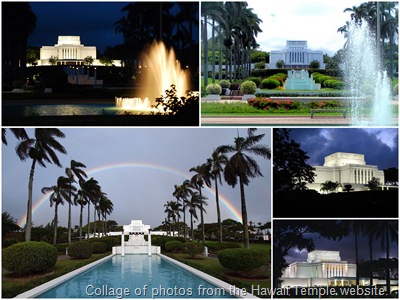
On the way back to Honolulu, we took the road that follows the coast. When we came across a sign for the Hawaii Temple of the Church of Jesus Christ of Latter-Day Saints in Laie, we had to make a detour. After all, we live in the state that the LDS settled when they were forced to leave Illinois in the mid-1800s. Here’s some information (source unidentified) that I found in my photo album.
With so many native Hawaiians joining the Church, it was deemed wise to provide a gathering place for the Saints so that they could better develop their own community. A Latter-Day settlement was attempted at Lanai, but was later abandoned.
In 1865, the Church purchased 6,000 acres (2,428 hectares) of land at Laie and designated the site as a new gathering place for the Saints. Believing that the Lord had sent them to this location, early Church members struggled to improve the land until, many years later, a garden paradise emerged. King Kalakaua visited the village in 1874, saying that there he felt, “perfectly at home.”
Along with the growth of the Church in Hawaii and the Pacific came the need for a temple. On June 1, 1915, Church president Joseph Smith visited the islands and dedicated the site for the temple. Construction began in 1916. Built from pulverized lava and reinforced concrete, the temple became one of the earliest examples of architectural concrete in America. The temple was completed in 1919 at a cost of more than $250,000. (Click the collage of photos above to visit the temple website.)

And so we wrapped up our second visit to Hawaii. We hope to return to the islands someday for a visit that’s longer than just a day or two.


